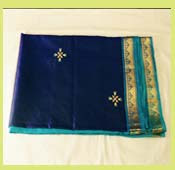
The previous blog on Kanchi silks gives all the needed information on this centuries old Kanchi silk. But even that can be made trendy and modern looking. Unlike the sarees posted on the previous blog this blog has sarees that are totally off-beat and very unusual. They make sarees that resemble Pavadi Davani. One of the sarees in the picture is of that kind. Also, sarees with no borders are made with motifs on the body of the saree and a very grand contrast pallu with a blouse matching to the pallu.
Monday, January 11, 2010
Kanchi Silk goes Trendy
The previous blog on Kanchi silks gives all the needed information on this centuries old Kanchi silk. But even that can be made trendy and modern looking. Unlike the sarees posted on the previous blog this blog has sarees that are totally off-beat and very unusual. They make sarees that resemble Pavadi Davani. One of the sarees in the picture is of that kind. Also, sarees with no borders are made with motifs on the body of the saree and a very grand contrast pallu with a blouse matching to the pallu.
ELEGANCE OF KANCHI SILK
Silk actually originated in China. But in India silk is synonymous with Kancheevaram. The most popular silk of all is the Kancheevaram silk or Kanchi silk. The place Kancheevaram is known for its weavers of silk material, pavadis and sarees. It takes more than a month to weave one single saree. Silk yarn is taken out of the silk-worms and then 2 or more colours are used to weave one saree with silver thread coated with gold. These are all reasons why a Kanchi saree is sold at high price. But silk is supposed to keep you cool in summer and warm in winter. Also, it lasts for decades if maintained carefully. It is quite low maintenance also.
Thursday, December 24, 2009
TUSSAR SILK
Tussar Silk, also known by its Sanskrit name Kosa silk, is produced from Tusser silkworms (Antheraea mylitta and Antheraea proylei). Produced mainly in the Indian state, Jharkhand, Tussar is valued for its texture and natural gold colour, which is unusually rich and deep.
Tussar Silk is a type of wild silk – it is obtained from silk worms that are not bred on mulberry trees but whose cocoons are collected from the local trees like Sal, Arjun and Saja. It is less expensive than cultivated silk and not as durable (cultivated silk has longer fibres). Some Tussar silk today is made is called non-violent silk, orAhimsa Silk, which is extracted from the cocoon after the silkworm larva has left it.
Traditionally, Tussar was dyed only with natural dyes – but with time, the range of colour and motifs has increased dramatically, thanks to the introduction of chemical dyes.
Tuesday, December 8, 2009
Zardosi work

Monday, August 31, 2009
Evening wear in Cotton silk
The most common look in cotton silk sarees for the past decade has been the more traditional looking sarees, with a solid body and contrast borders on both sides, and gold jari on it. These could be worn to temples, pujas, engagements ceremonies, 1st birthday pujas, upanayanams and even weddings. Then slowly- lines, plaid, and buttas (dots) came in style. The silk cotton has truly evolved over the years. These days it comes in designs where the top-half of the saree is of a different color with different designs and the lower half is of a different design and color.
Tuesday, August 25, 2009
Toned down appearance
Monday, August 24, 2009
Look grand and festive
Sunday, August 23, 2009
Antique Finish

As a follow up to yesterday's tip, I want to add by saying that the antique finish in the 1 gram jewelry is the one that makes it look extremely close to 22K gold jewelry. Those days of wearing bright gold earrings and necklace is all over, ladies These days it is all a dull finish or antique finish. Most of the one gram pieces are also antique finish ,which makes it resemble so much to its expensive counterpart. A piece that would cost 30,000 rupees or around 700 dollars would cost 60 dollars in one gram gold. Just a little tidbit I thought I would share!
Saturday, August 22, 2009
The Other Facet of RU Creations
Friday, August 21, 2009
Picture Perfect

When we take a look at the old antique Tanjore paintings, women are almost always highlighted. The magnificent lady featured is invariably either carrying a plate of fruits, daydreaming, or it is almost always a painting of Yasoda. The women always wore sarees, of course, and more interestingly, their blouses were always a total contrast and did not match the body of either the saree or the body.
Thursday, August 20, 2009
Deja Vu

In the 1980's, temple-border, or Gopuram border sarees, that were etched in Kanchi silk were all the rage. Basically, this was a solid color as the body, and the border had a contrast color with temple designs threaded in gold. The pallu was simple, and of course, in those days, they did not come with attached blouses.